
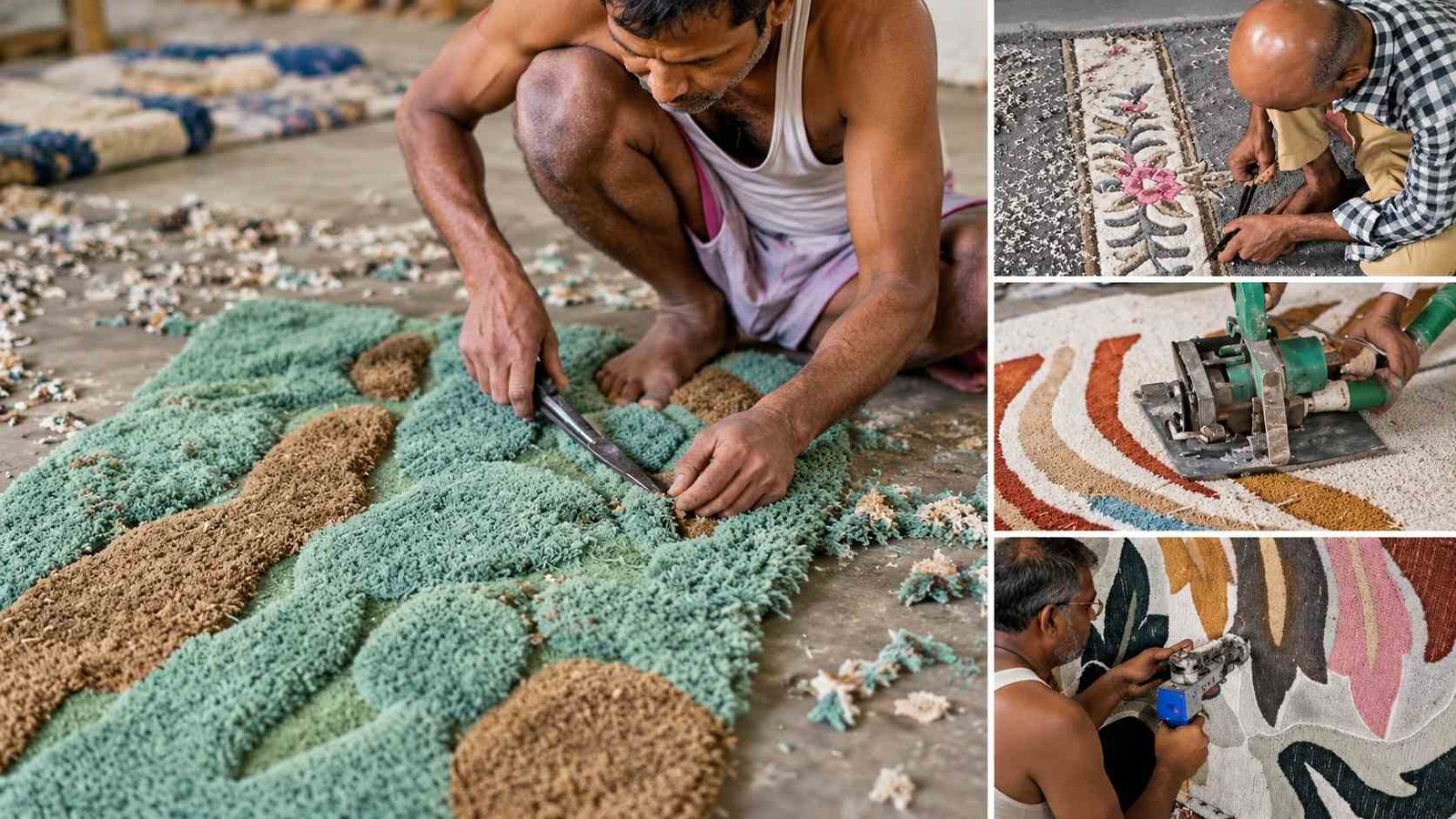
When you search for carpet India, you’ll find everything from traditional hand-knotted rugs to contemporary hand-tufted carpets made for modern homes. But what actually happens before a handmade carpet reaches your living room?
A large part of India’s carpet-making story begins in Bhadohi, Uttar Pradesh, a region widely known for its carpet manufacturing and weaving industry. Here, skilled artisans, specialised workshops and carpet businesses work with wool, yarn, design patterns and finishing techniques to turn raw materials into finished floor coverings.
At Indian Carpets, we manufacture hand-tufted rugs in our Bhadohi workshop. Understanding the production process helps you choose a carpet based on its construction, material, pile and intended use, rather than appearance alone.
In this guide, we’ll explain how handmade carpets are made, why Bhadohi is called the Carpet City of India, what separates hand-tufted and hand-knotted rugs, and what to check before buying one.
Table of Contents
Why is Bhadohi called the Carpet City of India?
Bhadohi is known as the Carpet City of India because of its established carpet-making industry and its concentration of weaving, manufacturing and finishing expertise. The wider Mirzapur-Bhadohi region is one of India’s important handmade carpet production centres.
The region has a long history of carpet weaving, with traditions commonly traced back to the Mughal period. Its carpet industry has developed across generations, serving both domestic buyers and international markets.
According to the Bhadohi district administration, the district is a major carpet manufacturing centre. The government also recognises the handmade carpet tradition associated with Bhadohi through the Geographical Indication (GI) framework.
The official GI registry lists “Hand made Carpet of Bhadohi” as a registered geographical indication.
What makes Bhadohi important to carpet manufacturing?
Bhadohi brings together several stages of carpet production. Depending on the manufacturer and construction method, these can include yarn preparation, design development, hand knotting or tufting, trimming, finishing, quality checks and packing.
The region is associated with different carpet styles, including hand-knotted designs, Indo-Persian patterns, shaggy carpets, tufted rugs and flat-woven floor coverings.
This variety matters because not every handmade carpet is produced in the same way. A traditional hand-knotted rug and a contemporary hand-tufted rug may both be handmade, but their construction, production time, price and maintenance requirements can differ considerably.
For buyers looking for carpet manufacturers in India, understanding these differences is a useful starting point.
How handmade carpets are made in Bhadohi
The manufacturing process depends on the type of carpet being produced. Hand-tufted and hand-knotted rugs use different techniques, so the steps below explain where their processes differ and how a finished carpet is prepared.
1. Selecting the right yarn and material
The first decision is the material. Wool is widely used in handmade carpets because it provides a resilient pile and a comfortable feel underfoot. Cotton is commonly used in carpet foundations, while viscose and silk can be selected for particular visual effects.
The right material depends on the intended design, budget, traffic level and maintenance expectations.
- Wool: A practical choice for many living rooms and bedrooms. Its natural crimp helps the pile recover from everyday compression, although performance depends on the wool grade, construction and density.
- New Zealand wool: Often selected for its softness and suitability for detailed pile carpets.
- Viscose: Can create a noticeable sheen and a silk-like appearance, but it generally needs more careful maintenance, particularly around moisture and spills.
- Cotton: Commonly used in foundations and backing systems, depending on the carpet construction.
A useful manufacturing detail is that fibre selection affects more than softness. Yarn thickness, twist and the way fibres sit in the pile influence how clearly a pattern appears and how the surface responds to foot traffic.
For example, a soft, high-pile rug may feel comfortable in a bedroom, while a lower, more compact pile can be easier to maintain in a frequently used living area.
If you’re comparing natural fibres, explore our wool rug collection.
2. Developing the design and colours
Once the materials are selected, the design is prepared. Depending on the project, it may begin as a drawing, a digital design or a pattern mapped onto a production backing.
The designer considers the dimensions, motif placement, border proportions and colour combinations before production starts.
A floral pattern with several small details requires a different approach from a plain rug with one consistent colour. Similarly, an irregular-shaped carpet needs its outline planned carefully so the final shape looks intentional rather than uneven.
Colour matching also requires attention. Two yarns that appear similar in a sample can look different when used across a large carpet, particularly when their texture or sheen differs.
For a custom rug, it helps to confirm the design, dimensions, material and colour references before manufacturing begins. This reduces the risk of misunderstandings during production.
3. Preparing the foundation
The foundation is the structure that supports the carpet. Its preparation depends on the construction method.
For a hand-tufted rug, a primary backing fabric is stretched securely across a frame. The design is transferred to this fabric, giving the artisan a guide for placing yarn in the correct areas.
For a hand-knotted carpet, the loom is prepared with warp threads. These threads form the lengthwise foundation onto which individual knots are tied.
This distinction is important when buying handmade carpets. The front of 2 rugs can look similar, but their foundations and construction may be completely different.
The backing is not simply a hidden component. It contributes to the rug’s structure, stability and ability to hold its pile in place.
4. Making a hand-tufted carpet
Hand tufting is one of the main methods used to produce contemporary handmade rugs. An artisan uses a tufting tool to insert yarn through a stretched primary backing, following the planned design.
The yarn forms loops or cut-pile tufts, depending on the intended finish. Different yarn colours are placed in their designated areas to build the pattern.
After tufting, the pile is secured with a suitable adhesive system. A secondary backing is then applied according to the rug’s construction specifications.
The surface is trimmed to create a more even pile. Additional carving may be used to define the boundaries between motifs or create differences in pile height.
At Indian Carpets, our Bhadohi workshop produces hand-tufted rugs. The method is particularly useful for contemporary patterns, detailed colour combinations, and custom shapes and sizes.
You can see examples in our hand-tufted carpets collection.
One point worth understanding: hand-tufted does not mean hand-knotted. Both involve skilled human work, but the yarn is secured differently. That difference affects the carpet’s structure, maintenance and expected lifespan.
5. Weaving a hand-knotted carpet
Hand knotting is a different, more time-intensive construction method. The artisan ties individual yarn knots around the foundation threads, row by row, following the design.
Each knot contributes to the carpet’s pile. Once a row is completed, the structure is compacted before the next row is made.
The total production time depends on the dimensions, knot density, design complexity, yarn and the speed of the weaving team.
A detailed pattern with many colour changes and fine motifs generally takes more work than a simpler design of the same size.
Hand-knotted carpets can have small variations in their knotting and pattern alignment because the work is done by hand. These variations should be assessed alongside the overall quality of the weaving and finishing.
If you want to understand the construction differences in more detail, read our guide to hand-knotted rugs vs hand-tufted rugs.
6. Trimming, shearing and carving the pile
After the pile has been formed, the carpet surface needs to be levelled and refined.
Shearing removes excess fibre and brings the pile closer to a consistent height. The appropriate pile height depends on the design and intended feel of the rug.
Carving is a separate finishing technique. The artisan trims around selected motifs or along pattern boundaries to make the design more distinct.
This is particularly useful for floral, abstract and high-low designs. A carved line can create a visible separation between two colours, while a difference in pile height can change the way light falls across the surface.
There is a practical detail here: a carved carpet may look different at different times of day. Natural light falling from one direction can create shadows around raised motifs, while light from another direction may make the same pattern look flatter.
Carving needs control. Cutting too deeply or inconsistently can affect the appearance of the pile, so the finishing work must suit the design and yarn.
7. Washing and final finishing
Washing and finishing requirements vary by carpet type, fibre, dyes, backing and production method. Where the construction allows it, cleaning removes loose dust and production residue.
The carpet is then dried under controlled conditions appropriate to its materials. Excess moisture must be managed carefully, especially when the rug contains moisture-sensitive fibres or adhesives.
Other finishing steps may include brushing, edge binding, trimming loose fibres, straightening the shape and inspecting the surface.
For some woven carpets, stretching is used to correct the shape before the final inspection. The exact process depends on the construction and the condition of the rug.
A carpet should be fully dry before it is packed. Packing a damp rug can create odour and other moisture-related problems during storage or transit.
8. Quality inspection and packing
Before a finished carpet is packed, it should be checked against the approved specifications.
The inspection may cover:
- Overall dimensions and shape.
- Colour consistency and pattern placement.
- Pile height and surface uniformity.
- Edge finishing and backing condition.
- Loose yarn, visible defects and finishing quality.
- Cleanliness and readiness for packing.
For a custom order, the approved design and dimensions are especially important. A rug can be well made but still be unsuitable for a room if its final size or colour balance differs from what was agreed.
Once the carpet passes inspection and is dry, it can be prepared for storage or shipping.
Hand-tufted vs hand-knotted carpets: what is the difference?
Both methods can produce attractive handmade rugs, but their construction differs.
| Feature | Hand-tufted carpet | Hand-knotted carpet |
|---|---|---|
| Construction | Yarn is inserted through a primary backing using a tufting tool | Individual knots are tied around foundation threads |
| Production time | Generally shorter for comparable designs | Often longer, depending on knot density and complexity |
| Design flexibility | Well suited to contemporary patterns and custom shapes | Well suited to detailed woven designs and traditional patterns |
| Structure | Tufts are secured with a backing and adhesive system | Knots form the pile structure around the foundation |
| Maintenance | Depends on fibre, pile, backing and adhesive system | Depends on wool quality, knotting, pile and finishing |
| Cost | Often more accessible for comparable sizes and designs | Can cost more because of the labour and time involved |
Neither method is automatically better for every room. Your decision should depend on the budget, construction, material, appearance and how the carpet will be used.
For example, a custom hand-tufted rug may be suitable when you want a specific colour palette, a contemporary motif or an unusual outline. A hand-knotted rug may be the right choice when you value its particular weaving tradition and construction.
What should you check when buying handmade carpets online in India?
Buying carpets online in India gives you access to different designs and sizes, but product photographs alone cannot tell you everything about a rug.
Before ordering, check the following details.
Confirm the material
Look for the stated fibre composition rather than relying on words such as soft or premium. A wool rug, viscose rug and synthetic rug can have different appearances and care requirements.
If a product contains a blend, check the proportions where they are provided.
Check the construction
Confirm whether the rug is hand-tufted, hand-knotted, handwoven or machine-made. These terms describe different construction methods and should not be used interchangeably.
Choose the right dimensions
Measure the room and decide how much floor should remain visible around the rug. In a living room, consider the relationship between the rug, sofa and coffee table. In a bedroom, consider whether the rug should extend beyond the sides and foot of the bed.
Our rug size guide for Indian homes can help you plan the dimensions.
Ask about pile height and care
A deep pile has a different feel from a low pile and can require more effort to clean. If the carpet will be placed in a busy area, consider how easily dust and debris can be removed.
Ask for fibre-specific care instructions, especially if the rug contains viscose or other delicate materials.
Review customisation and delivery details
For a custom rug, confirm the dimensions, design, material, colour references and expected production timeline. Ask how the final piece will be inspected and packed.
If you’re comparing local options before buying, read our guide to finding a reliable carpet shop near me to understand what to look for when choosing a carpet retailer.
What affects carpet flooring price in India?
Carpet flooring price in India depends on several factors, and the price of a loose handmade area rug should not be confused with the price of wall-to-wall carpet flooring.
For handmade rugs, the main cost factors include:
- Size: Larger rugs require more material and production work.
- Fibre: Wool, viscose, silk and synthetic fibres differ in cost and performance.
- Construction: Hand knotting, hand tufting and other methods require different amounts of labour and materials.
- Design complexity: Intricate patterns, multiple colours and detailed carving can add production time.
- Pile and finishing: Pile height, density, edge work and final finishing influence the finished product.
For installed carpet flooring, the calculation may also include the carpet type, underlay, installation labour, room preparation and wastage.
There is no single price that accurately describes every handmade carpet made in India. Compare products with similar dimensions, materials and construction before deciding which offers the best value for your needs.
How to care for a handmade carpet after delivery
Good care helps preserve the appearance of your carpet and reduces avoidable wear.
Vacuum regularly. Use a setting suitable for the pile and fibre. Avoid aggressive beater-bar action on delicate or loosely constructed rugs.
Rotate the rug. Where practical, rotate it periodically to distribute foot traffic and sunlight exposure more evenly.
Blot spills promptly. Use a clean, absorbent cloth and press gently. Avoid rubbing, which can spread the spill or damage the pile.
Keep moisture under control. Do not leave a rug damp after cleaning. Follow the material-specific instructions before using any cleaning solution.
Use suitable professional cleaning. Wool, viscose and silk require different treatment. Test any approved spot-cleaning method in an inconspicuous area, and seek professional advice for delicate fibres or difficult stains.
Protect against prolonged direct sunlight. Strong sunlight can gradually change the appearance of some fibres and dyes. Curtains, blinds and regular rotation can help reduce uneven fading.
A handmade carpet does not need complicated care every day. Regular attention and the correct cleaning method are more useful than harsh products or excessive washing.
Indian Carpets: handmade rugs from Bhadohi
Indian carpets reflect several construction traditions, material choices and design approaches. Bhadohi remains an important part of this industry because of its manufacturing expertise and established carpet-making community.
At Indian Carpets, we make hand-tufted rugs in our Bhadohi workshop, with attention to the design, material, pile and finishing requirements of each piece.
If you’re comparing handmade carpets, start with the construction method and fibre composition. Then consider the dimensions, colour, pile height and maintenance requirements that suit your room.
You can explore our carpet collection or contact Indian Carpets to discuss a particular design, size or custom requirement.
The right carpet is one that fits your space, suits your daily use and has a construction you understand before you buy.
Frequently asked questions
1. Which city is known as the Carpet City of India?
Bhadohi in Uttar Pradesh is widely known as the Carpet City of India. The district has an established carpet manufacturing industry and is associated with a range of handmade carpets and weaving traditions.
2. How are handmade carpets made in Bhadohi?
The process depends on the construction method. Hand-tufted carpets are made by inserting yarn through a backing with a tufting tool, then securing and finishing the pile. Hand-knotted carpets are made by tying individual knots around foundation threads. Both may require trimming, inspection and other finishing steps.
3. Who are the carpet manufacturers in India?
India has carpet manufacturers and weaving centres in several regions, including Bhadohi and Mirzapur in Uttar Pradesh, Jaipur in Rajasthan, Panipat in Haryana and Kashmir. Each region has its own production strengths, materials and design traditions.
When choosing a manufacturer, check the construction method, material specifications, quality inspection process and ability to meet your requirements.
4. Are hand-tufted carpets handmade?
Yes. Hand-tufted carpets are made by artisans who insert yarn into a backing using a tufting tool. The pile is then secured and finished. Hand tufting is different from hand knotting, where individual knots are tied around the foundation threads.
5. Are hand-knotted carpets better than hand-tufted carpets?
Not in every situation. Hand-knotted carpets use individual knots and can require considerably more production time. Hand-tufted carpets offer a different construction that can be suitable for contemporary designs and custom dimensions. The better choice depends on your budget, design preference, intended use and care expectations.
6. What affects the price of handmade carpets in India?
The main factors are size, fibre composition, construction, design complexity, pile height and finishing. Hand-knotted rugs often require more labour time than comparable hand-tufted rugs, but actual prices depend on the individual specification.
7. Can I order a custom handmade carpet from India?
Yes. Many carpet manufacturers offer custom options, depending on their production capabilities. Before placing an order, confirm the size, material, design, colour references, construction method and production timeline.
8. How do I choose a handmade carpet for my living room?
Measure the seating area first, then decide how the rug should sit beneath the sofa and chairs. Consider the pile height, fibre, expected foot traffic and cleaning requirements. Choose a design that works with your existing furniture and colour palette.
9. Do handmade wool carpets shed?
Some wool carpets release loose fibres, particularly during their initial period of use. The amount depends on the wool, yarn construction, pile and manufacturing quality. Regular, gentle vacuuming usually helps remove loose surface fibres. Persistent or excessive shedding should be assessed against the product’s construction and care instructions.
10. Can I buy carpets online in India directly from a manufacturer?
You can purchase carpets online from retailers and manufacturers that sell through their websites. Check the product specifications, dimensions, construction, shipping terms and return policy before ordering. For custom rugs, confirm the approved details with the manufacturer before production starts.