Carpet shop near me is one of those searches you make when you want to see rugs, compare prices, check materials and speak with someone who understands carpets. But the closest shop isn’t always the right one.
A good carpet dealer should help you understand construction, material, size, pile, finish, care and suitability for your room before you buy.
If you’re looking for handmade carpets, the difference becomes even more important. A hand knotted rug and a hand tufted rug can look similar in photographs while being very different in how they’re made, priced and maintained.
This guide explains what to check when choosing a carpet shop near you, whether you’re shopping for a living room, bedroom, dining area, office, hotel or a custom project.
What should you look for in a carpet shop near me?
A reliable carpet shop should be able to explain where a rug comes from, how it was made, which materials were used, what its construction is, and how it should be maintained.
Before buying, ask about:
- Material and yarn
- Hand knotted, hand tufted, hand loom or flatweave construction
- Pile height and density
- Available sizes
- Custom sizing
- Cleaning and maintenance
- Delivery time
- Return and purchase terms
- Suitability for your room and traffic level
A shop that can answer these questions clearly gives you much more useful information than a showroom that only tells you a carpet is “premium.”
Carpet dealers near me: what should you check before buying?
When comparing carpet dealers near me, start with the rug itself rather than the sales pitch.
Run your hand across the pile. Look at the back. Check whether the edges are properly finished. Examine the density of the yarn and the consistency of the surface.
For handmade carpets, small variations can occur because the rug is produced by hand. Those variations should be understood as part of the production process rather than automatically treated as defects.
1. Ask how the carpet was made
Construction affects the appearance, feel, durability and price of a rug.
A hand knotted rug is built knot by knot on a loom. The process takes considerably longer than tufting, and the density and knot structure have a major effect on the finished piece.
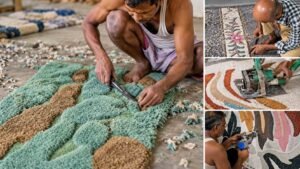
A hand tufted rug is made by inserting yarn into a stretched foundation with a tufting tool. The pile can then be trimmed, carved and finished to create different textures and patterns.
Flatweaves use a woven structure without a deep pile. They can work well where you want a flatter surface and easier movement of furniture.
Knowing the construction helps you compare two rugs fairly.
2. Look beyond the top surface
Two carpets can have a similar pattern while having very different construction underneath.
Turn the rug over and examine the backing and finishing. On a handmade rug, the back can tell you a great deal about its construction.
Check the edges and corners too. They should sit properly without obvious loose sections.
For a tufted rug, ask about the backing system and how the pile has been secured. For a hand knotted rug, look at the knot structure and overall density.
These details are more useful than judging quality from photographs alone.
3. Ask about the fibre
The material should match the room and the way you intend to use the rug.
New Zealand wool is valued for its softness, resilience and ability to hold yarn well. Wool is commonly chosen for living rooms, bedrooms and other areas where comfort underfoot matters.
Indian wool can also be used for handmade carpets, with the final feel depending on the wool quality, yarn preparation, density and construction.
Silk and Kashmiri silk can create a fine surface and detailed visual effect. They generally need more careful placement and maintenance than a hard-wearing wool rug.
Bamboo silk and viscose can provide a soft hand and a subtle sheen. They can be useful for decorative areas, although care requirements should be considered before choosing them for heavy-traffic rooms.
Cotton and natural fibres such as jute can suit particular styles and room settings.
The right material depends on your room, traffic, pets, sunlight, cleaning routine and budget.
Hand knotted vs hand tufted carpets: which should you choose?
If you’re comparing handmade rugs at a carpet shop near you, construction is one of the first things worth understanding.
| Feature | Hand knotted | Hand tufted |
|---|---|---|
| Production | Individual knots made on a loom | Yarn inserted into a foundation |
| Production time | Usually longer | Usually faster |
| Surface | Can be finely detailed and dense | Can have deep, sculpted or carved pile |
| Design | Detailed patterns are possible | Broad range of patterns and textures |
| Price | Often higher | Usually more accessible |
| Best for | Long-term use and fine craftsmanship | Decorative interiors and custom designs |
Neither construction is automatically right for every room.
If you want a densely constructed rug with a long service life and are comfortable with a higher investment, hand knotted construction may suit you.
If you want a custom shape, carved texture, particular pile height or a more accessible handmade option, hand tufting can be a practical choice.
Which types of carpets can you find at a good local carpet dealer?
The phrase carpet shop near me can cover very different products. A specialist rug dealer may carry several constructions, materials, shapes and styles.
Hand knotted rugs
Hand knotted rugs are made by tying individual knots around the foundation structure. Their density, yarn quality and knot count influence the final appearance and feel.
They work particularly well in living rooms, formal sitting areas, bedrooms and spaces where the rug will remain in place for years.
Hand tufted carpets
Hand tufted carpets allow designers to create different pile heights, textures and carved surfaces.
High-low carving can give a pattern more depth because areas of the pile are cut to different heights. The effect can change as daylight moves across the room.
Shaggy carpets
Shaggy rugs have a longer pile and a softer, more relaxed feel.
They’re often suited to bedrooms, lounges and low-traffic areas. Because longer fibres hold more dust, regular care is especially important.
Explore shaggy carpets at Indian Carpets
Round rugs
Round rugs can help break up rooms dominated by straight furniture lines.
They’re useful beneath small seating groups, beside beds, in reading corners and in selected dining spaces where the table shape allows enough clearance.
Irregular rugs
Free-form and irregular rugs can work well when a standard rectangle feels too predictable for the room.
They can be particularly useful in creative studios, lounges and interiors where the rug itself is part of the visual composition.
How do you choose the right rug size?
A common mistake when shopping at a carpet store is choosing the rug based only on its appearance.
Measure the furniture first.
For a living room, decide whether you want all major seating pieces to sit on the rug or whether the front legs will sit on it.
For a bedroom, an 8×10 rug can work well around a queen-size bed when the room allows enough space around the bed. Larger rooms may need a 9×12 or another larger format.
For dining rooms, leave enough rug area around the table so chairs remain on the rug when pulled out.
The rug should relate to the furniture rather than simply fill empty floor space.
What colours work best when buying from a carpet shop near me?
Start with the room rather than the rug.
Look at your sofa, flooring, curtains, walls and wood tones.
If your room already contains several strong colours, a neutral beige, cream, off-white, tan or soft grey rug can calm the composition.
For a smaller room, lighter neutrals can reflect more available light and make the space feel more open.
If the furniture is restrained, a rug with stronger pattern or colour can become the visual anchor.
Also consider everyday use. Mid-tone colours and patterned surfaces can be more forgiving of normal dust and small marks than very pale solid surfaces.
How can you tell if a handmade rug is well made?
A few simple checks can tell you more than a sales description.
Check the pile
Run your hand across the surface. A good rug should have a consistent pile appropriate to its construction.
Very high pile isn’t automatically better. Pile height should suit the room and how you use it.
Check the density
Denser construction generally creates a fuller surface, although density needs to be judged alongside fibre, yarn thickness and construction.
A dense hand tufted rug can have a different feel from a lower-density rug even when both use the same fibre.
Look at the carving
On carved rugs, inspect the transitions between pile heights. Clean carving should create a clear difference between the raised and recessed areas.
Natural light can make these areas appear different throughout the day.
Inspect the finishing
Look at the edges, corners and backing.
Proper finishing matters because the rug has to remain stable after production, washing and handling.
Ask about maintenance
A dealer should be able to tell you how the rug should be vacuumed, what kind of cleaning it needs and whether professional washing is recommended.
Can a local carpet dealer make a custom rug?
Yes, many specialist carpet manufacturers and dealers work on custom rugs.
Customisation can include:
- Size
- Shape
- Colour palette
- Pattern
- Material
- Pile height
- Carving
- Border treatment
Custom sizing is particularly useful when a standard 8×10, 9×12 or other stock size doesn’t fit the room correctly.
Large custom rugs also need planning for production, finishing, washing, drying and final inspection. After washing, a large rug may need minor stretching before final trimming so the finished dimensions are correct.
If your project requires a specific size or design, you can explore the custom rug service from Indian Carpets.
Create a custom rug with Indian Carpets
Carpet shop near me or buying online: which is better?
Both can work when the seller provides enough information.
A showroom gives you the chance to see the actual colour, feel the pile and judge the scale in person.
Online shopping gives you access to a larger collection and makes it easier to compare products from home.
For handmade rugs, ask the online seller for clear information about:
Material: What fibre is used?
Construction: Is it hand knotted, hand tufted or woven?
Size: What are the exact finished dimensions?
Pile: What is the pile height?
Backing: How is the rug finished?
Care: How should it be cleaned?
Customisation: Can the size or colour be changed?
A good online listing should answer these questions before you need to contact the seller.
Shop handmade rugs and carpets from Indian Carpets
What questions should you ask carpet dealers near me?
Before paying for a rug, ask:
- What is the carpet made from?
- Is it hand knotted, hand tufted or machine made?
- What is the pile height?
- How dense is the construction?
- Is the colour suitable for my room’s lighting?
- What size would you recommend for my furniture?
- Can you make this carpet in a custom size?
- How should I clean and maintain it?
- Is professional washing required?
- What happens if the rug needs repair or restoration later?
The answers will help you compare dealers based on knowledge rather than appearance alone.
How should you care for a new handmade carpet?
Care depends on the material and construction, but a few habits are useful.
Vacuum regularly to prevent dust from settling deep into the pile. Avoid aggressive brushing, especially on delicate fibres or long-pile rugs.
New wool rugs can shed some loose fibres during the early period of use. This usually reduces as the rug settles, although the amount varies with construction, yarn and use.
Keep rugs away from prolonged direct sunlight when the fibre or dye is sensitive to light.
For spills, deal with them promptly rather than allowing moisture to remain in the pile.
For washing, use a cleaner who understands handmade rugs. Improper washing can affect shape, backing, dyes or pile.
Where can Indian Carpets fit into your search for a carpet dealer near me?
Indian Carpets creates handmade rugs and carpets for homes, designers, architects, hotels and commercial spaces.
The collection includes hand knotted and hand tufted carpets, along with shaggy, round, irregular and other rug formats.
Material choices include wool, New Zealand wool, Indian wool, silk, bamboo silk, viscose and other fibres depending on the design.
If you’re comparing carpet dealers, the useful question is whether the seller can help you match construction, material, size and design to your actual space.
For a living room, you may want a dense wool rug that works with everyday foot traffic.
For a bedroom, a softer pile may be more comfortable.
For a formal room, a finer hand knotted construction may make sense.
For an unusual floor plan, an irregular or custom-sized rug may fit better than a standard rectangle.
Explore the Indian Carpets collection
A simple checklist before you buy
If you’re standing in a carpet showroom or comparing products online, use this quick checklist:
Measure the room.
Know the available floor area and furniture placement.
Choose the construction.
Decide whether hand knotted, hand tufted or flatweave suits your use.
Choose the fibre.
Match wool, silk, viscose, bamboo silk or another material to traffic and maintenance needs.
Inspect the finish.
Look at the pile, backing, edges and corners.
Think about maintenance.
Ask how the carpet should be vacuumed and washed.
Ask about custom sizes.
A made-to-measure rug can solve awkward room proportions.
Compare the whole product.
Price should be considered alongside construction, fibre, density, size and workmanship.
Frequently asked questions about carpet shops near me
What should I look for in a carpet shop near me?
Look for a dealer that can clearly explain carpet construction, material, pile, sizing, maintenance and customisation. If you’re buying handmade rugs, ask how the rug was produced and inspect the back, edges, pile and finishing before making a decision.
How do I find reliable carpet dealers near me?
Search local listings, reviews and carpet showrooms, then compare what each dealer actually provides. Look for clear product information, knowledgeable staff, realistic delivery times, transparent purchase terms and the ability to explain materials and construction.
Is it better to buy a carpet from a local dealer?
A local dealer can be useful because you may be able to see the rug in person, feel the pile and discuss your room with someone directly. Online buying can also work when product specifications, photographs, dimensions and care information are clearly provided.
What is the difference between hand knotted and hand tufted rugs?
Hand knotted rugs are made by tying individual knots onto a loom. Hand tufted rugs are made by inserting yarn through a foundation using a tufting tool. Hand knotted rugs generally take longer to produce, while hand tufting allows efficient production of many pile heights, shapes and carved designs.
Which carpet material is best for a living room?
Wool is a common choice for living rooms because it combines comfort with resilience. New Zealand wool can provide a soft, dense pile when properly constructed. The right choice still depends on traffic, furniture, pets, sunlight and your maintenance routine.
Can carpet dealers make custom-size rugs?
Many specialist carpet manufacturers can produce rugs in custom sizes. Custom orders can also involve changes to colour, shape, pattern, material and pile. Ask about production time and finishing requirements before placing the order.
How do I choose the right carpet size?
Measure the room and furniture first. In a living room, the rug should relate to the seating arrangement. In a bedroom, an 8×10 or larger rug may work well around a queen-size bed when space allows. Dining rugs should leave enough room for chairs to remain on the rug when pulled out.
Do handmade wool rugs shed?
Some handmade wool rugs can shed loose fibres, especially during the first period of use. The amount depends on wool, yarn, pile and construction. Regular vacuuming with suitable settings can help remove loose fibres without putting unnecessary stress on the rug.
How should handmade carpets be cleaned?
Vacuum regularly using a suitable setting for the rug. Deal with spills promptly and avoid harsh chemicals. For washing, use a professional cleaner familiar with handmade carpets because water, drying, dyes and backing all need to be handled correctly.
Are carpet shops near me only useful if I want to visit a showroom?
No. A local carpet dealer can still be useful for consultation, custom orders and after-sales questions even when you eventually buy online. The key is having enough product information to make a sound comparison.
Final thoughts
A search for carpet shop near me should lead to more than the closest store on a map.
Take a little time to understand the rug you’re buying. Check its construction, material, pile, density, size and finishing. Think about how the rug will be used and how much care you’re willing to give it.
When you compare carpet dealers near me, choose a seller who can explain those details clearly and help you select a rug that fits your room, budget and daily use.
If you’re looking for handmade Indian carpets, you can browse the Indian Carpets collection online or contact the team about a custom requirement.