
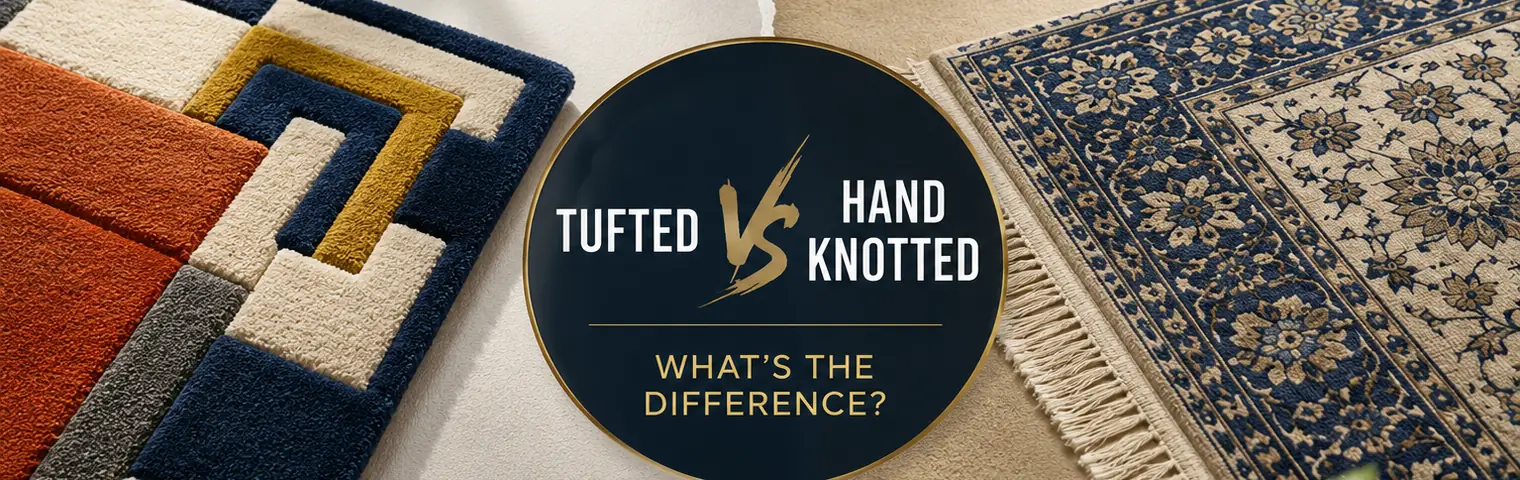
If you’re comparing a hand tufted rug with a hand knotted rug, the biggest difference is how the yarn becomes part of the rug.
A hand tufted rug is made by pushing yarn through a prepared backing. A hand knotted rug is built knot by knot, with each knot tied into the foundation by hand.
Both can produce beautiful handmade rugs. The better choice depends on what you care about most: price, construction, surface detail, durability, design, room use, or how long you expect the rug to stay with you.
Table of Contents
Hand tufted vs hand knotted rugs at a glance
| Feature | Hand tufted rug | Hand knotted rug |
|---|---|---|
| Main construction | Yarn is inserted through a backing | Individual knots are tied by hand |
| Production time | Usually shorter | Usually longer |
| Design flexibility | Very high | Very high |
| Surface detail | Works well with carving and varied pile | Can achieve very fine pattern detail |
| Backing | Usually includes a secondary backing | The knotted foundation forms the structure |
| Initial cost | Generally more accessible | Generally higher |
| Durability | Depends on fiber, density and construction | Can be extremely durable when well made |
| Custom sizes | Yes | Yes |
| Best suited to | Design-led interiors and many custom projects | Detailed rugs intended for long-term use |
There isn’t a single construction that works for every room.
A well-made rug starts with the right combination of fiber, yarn, density, pile, construction and finishing.
What is a hand tufted rug?
A hand tufted rug is made by inserting yarn through a stretched primary backing. A tufting tool pushes the yarn through the backing according to the design.
Once the pile has been built, the surface is trimmed to the required height. Some rugs are then carved to create different levels, sharper pattern definition or a more sculptural surface.
The back is secured and covered with a secondary backing before the rug goes through finishing.
That construction gives a designer a lot of freedom.
A hand tufted rug can have a simple cut pile, a thicker pile, carved sections, geometric patterns, floral designs or abstract artwork. The surface can be kept relatively flat or given more texture through different pile heights.
How a hand tufted rug is made
The basic process looks like this:
- The design is prepared on the backing.
- Yarn is inserted through the backing with a tufting tool.
- The pile is built according to the pattern.
- The surface is sheared to an even height.
- Selected areas can be carved or left at different heights.
- The back is secured and covered.
- The rug is trimmed and finished.
- Washing, drying and final inspection follow where required.
The details matter.
Yarn thickness changes how full the surface feels. Pile height changes the way your feet feel the rug. Carving changes how light falls across the pattern.
That’s why two hand tufted rugs can look and feel very different even though they use the same basic construction.
What are hand knotted rugs?
Hand knotted rugs are made by tying individual knots into the rug’s foundation.
An artisan works across the design row by row. The number and type of knots, yarn thickness, pattern complexity and rug size all affect how much work goes into the finished piece.
After the knotting is complete, the rug is sheared to establish the pile height. It can then go through washing, drying, stretching, trimming and other finishing processes.
This is a slower construction method because the pile itself is created through individual knots.
A detailed hand knotted carpet can require a great deal of careful work before it reaches the finishing stage.
Why knot density matters
Knot count gives you useful information, but it doesn’t tell the whole story.
Two rugs can have different knot counts and still have different characteristics because fiber quality, yarn thickness, design, pile height and finishing all affect the final rug.
For a buyer, the better question is:
How does the construction work with the material and the way you’ll use the rug?
A dense wool rug intended for everyday use has different requirements from a fine decorative rug that sits in a quieter room.
Hand tufted vs hand knotted: the main construction difference
The easiest way to understand the difference is to look at what creates the pile.
With a hand tufted rug, yarn is pushed through a backing. The backing and finishing materials become part of the finished construction.
With a hand knotted rug, individual knots form the pile and are tied into the foundation as the rug is made.
You can see why production time can differ considerably.
A hand tufted construction lets artisans build a large surface relatively quickly. Hand knotting requires each knot to be tied into position.
That difference affects labor, production time and usually the price.
Hand tufted vs hand knotted: appearance and texture
Construction also changes the way a rug feels and looks.
Hand tufting works particularly well when you want carved details, different pile heights or strong surface texture.
For example, a geometric pattern can be cut at one height while selected lines are carved slightly deeper. When light moves across the room, those small changes in height create shadows on the surface.
Wool is especially useful for this kind of work because its natural texture gives the pile a soft, matte appearance.
Hand knotted rugs can also have rich surface detail. Fine knotting allows detailed patterns to be built directly into the structure of the rug.
The final feel depends on more than construction. Wool quality, yarn thickness, pile height and finishing all matter.
Which is more durable, hand tufted or hand knotted?
This is where simple comparisons can become misleading.
A good hand knotted rug can last for decades when made with suitable materials and cared for properly. A well-made hand tufted rug can also perform very well when its construction matches the room and level of use.
Think about the whole specification.
Fiber matters.
New Zealand wool and Indian wool have different characteristics from viscose or silk. A wool rug intended for regular foot traffic needs a different care routine from a delicate decorative rug.
Density matters.
A well-filled pile generally feels different underfoot from a sparse pile.
Pile height matters.
A very high pile can feel soft and comfortable, but it may require more attention in busy areas.
Usage matters.
A rug under a coffee table in a quiet sitting room doesn’t experience the same wear as one in a hallway.
So when you’re choosing between hand tufted and hand knotted, look at the complete construction rather than the label alone.
Which is more expensive?
Hand knotted rugs generally cost more because the production process requires individual knots and considerably more artisan labor.
The final price still depends on the specific rug.
Size makes a difference. So does knot density, fiber, yarn quality, pattern complexity and finishing.
A large hand knotted wool rug with a detailed design requires far more work than a small rug with a simpler pattern.
Hand tufted construction can reduce production time, which makes it a practical option when you want a handmade rug with a particular design while keeping the initial cost more controlled.
If you’re working on a custom project, the best approach is to discuss the intended size, material, design and room before choosing the construction.
Hand tufted rug or hand knotted rug for a living room?
Both can work in a living room.
The decision should start with the furniture layout and traffic level.
For a large seating arrangement, an 8×10 or 9×12 rug can give the furniture enough visual space to sit together. The exact size still depends on the room.
A hand tufted rug can be a good fit when you want an abstract design, carved pattern or a particular color combination.
A hand knotted wool rug can suit a room where you want detailed pattern work and a construction intended for long-term use.
The important part is matching the rug to the room rather than choosing a construction simply because it sounds more expensive.
Hand tufted vs hand knotted for bedrooms
Bedrooms usually give you more flexibility because foot traffic tends to be lower than in entrances and hallways.
A soft wool hand tufted rug can work well beside a bed or underneath a larger bed arrangement. A hand knotted rug can also work beautifully when you want a more detailed pattern or traditional surface.
Think about where your feet land in the morning.
If the rug sits beside the bed, softness and pile height may matter more than maximum durability.
If the rug extends well beyond the bed and becomes a major part of the room’s design, pattern, size and color deserve more attention.
Which materials work with hand tufted and hand knotted rugs?
Construction is only half of the decision.
Wool
Wool is a practical choice for many handmade rugs. Indian wool and New Zealand wool are both used in rug production, with differences in fiber characteristics, feel and appearance.
Wool also works well for many textured and carved designs.
Silk and bamboo silk
Silk and bamboo silk can create a finer surface and a noticeable sheen.
They’re particularly useful when the visual quality of the fiber is part of the design. Care requirements should be considered before placing these rugs in busy areas.
Viscose
Viscose has a soft feel and a distinctive sheen.
It needs more careful handling than a hard-wearing wool rug, especially in areas exposed to spills and heavy traffic.
Cotton
Cotton can be used in different parts of handmade rug construction, including backing and foundation applications depending on the rug.
Its role should be considered together with the rest of the construction rather than judged on its own.
Indian Carpets works with materials including wool, New Zealand wool, Indian wool, silk, bamboo silk, viscose and cotton, giving you different options depending on the design and intended use.
How to tell if a rug is hand knotted
If you’re buying a hand knotted rug, look at the back.
The reverse side can reveal the structure of the rug and give you clues about how the knots were formed. You can also examine the fringe and the pattern on the back.
For an expensive rug, ask the seller or manufacturer directly about:
- Construction method
- Fiber
- Knot density
- Pile height
- Backing
- Finishing
- Cleaning requirements
You shouldn’t have to guess what you’re buying.
Indian Carpets also has a dedicated guide on how to tell if a rug is hand knotted, so this comparison can work as the starting point before you move into the more detailed identification process.
Can hand tufted and hand knotted rugs be custom made?
Yes. Both constructions can be used for custom rug projects.
The practical difference is in how the design is produced.
For a custom hand tufted rug, you can work with the manufacturer on:
- Size
- Shape
- Colors
- Pattern
- Pile height
- Carving
- Material
- Finishing
Hand knotted rugs can also be made to specific sizes, colors, patterns and material requirements.
Custom work becomes easier when you provide the room dimensions, furniture layout, preferred colors and a clear reference for the design.
You can explore Indian Carpets’ custom rug service when your required size or design doesn’t fit a standard collection.
Hand tufted vs hand knotted: which should you choose?
Choose a hand tufted rug when you want a handmade construction with broad design flexibility, custom shapes, carved surfaces or a more accessible starting price.
Choose hand knotted rugs when you place greater weight on traditional knotting, detailed construction and long-term use.
Your room should make the final call.
A busy living room needs a different specification from a quiet bedroom. A family home has different requirements from a decorative hotel lobby. And a rug made from wool has different care needs from one made from viscose.
That’s why we look at construction, material, pile, density and room use together.
Hand tufted vs hand knotted: common questions
Is a hand tufted rug handmade?
Yes. Hand tufted rugs are made by inserting yarn through a backing using a tufting tool. The surface is then trimmed, finished and backed according to the construction.
Are hand knotted rugs more durable?
A well-made hand knotted rug can have a very long service life. Actual durability depends on fiber quality, density, construction, traffic and care.
Is hand tufted carpet good for everyday use?
It can be. Choose the material, pile height and density according to the amount of traffic the room receives.
Why are hand knotted rugs more expensive?
The individual knotting process requires more artisan labor and production time. Size, knot density, materials and pattern complexity also affect the price.
Which is better for a living room, hand tufted or hand knotted?
Both can work. Hand tufted rugs give you considerable freedom with contemporary patterns and carved surfaces. Hand knotted rugs suit buyers looking for detailed construction and long-term use.
Can a hand tufted rug be made in a custom size?
Yes. Custom hand tufted rugs can be produced in specific sizes, shapes, colors and designs depending on the project.
How do I know if my rug is hand knotted?
Check the back, examine the knot structure and ask the manufacturer about the construction. The reverse side often gives useful clues.
The right rug starts with the right construction
Hand tufted and hand knotted rugs come from different production methods, and each has a place in a well-designed home.
If you want design freedom, carved surfaces and a handmade rug at a more accessible starting price, hand tufted construction is worth considering.
If you want individual knotting, detailed craftsmanship and a rug intended for long-term use, hand knotted construction deserves a closer look.
Then bring the material into the decision. Wool, New Zealand wool, Indian wool, silk and viscose behave differently. So do different pile heights and densities.
At Indian Carpets, the aim is simple: help you choose a rug that makes sense for your room, your design and the way you live with it.
Explore our hand tufted carpets or shop all rugs, or speak with us about a custom rug when you need a specific size or design.